Andreas S. Kronfeld's Home Page
Most of my research
focuses on lattice gauge theory, particularly on the quest to make
reliable calculations of hadronic matrix elements. These are needed, in
particular, to interpret experiments studying the B meson at Fermilab's Tevatron, KEK's KEK-B, and SLAC's PEP-II
accelerators. A large part of this effort is devoted towards developing
and improving methodology (reviewed here),
but it is also important to do calculations of broad interest (reviewed here).
As an outgrowth of this work, I have been involved some collaborative
efforts between theorists and experimentalists, organizing a workshop on B Physics at the Tevatron,
and participating in CERN's CKM
Unitarity Triangle Workshop.
In recent years I
have also been involved in studies of the physics potential of
linear e+e- colliders.
Curriculum vita and
list of publications
(also available as one sequential list,
or try
inSPIRE HEP), as of October 2012.
Briefly, I received my Ph.D. from
Cornell University in
1985, after which I was a post-doc at DESY
for three years. I have been at Fermilab
since 1988.
Lattice QCD and
Flavor Physics
The Golden Era of Lattice QCD
In 2003, a
collaboration of Collaborations discovered that lattice QCD with 2+1
flavors of sea quarks agreed with experiment for a wide variety of
gold-plated quantities:
This striking
development, among other things, led to a vigorous dialogue about the
theoretical foundations of the way the sea quarks are treated in this paper
(namely, with rooted, staggered fermions).
In 2007 I wrote a summary of the arguments in favor, a
list of recent theoretical papers, and a refutation a specific claims
against.
Predictions from
Lattice QCD
In 2004–2005
we then aimed to predict several other gold-plated quantities:
These results were
later confirmed by several experimental measurements.
This development is summarized in:
As the
measurements of one of these quantities—the decay constant of the
Ds meson—improved, the measurement deviated from
the calculation
(of another group)
by 3.8σ.
The D+, K, and π decay constants (which are
harder to control) remain in agreement.
The deviation can be interpreted as a signal of non-Standard physics:
Clearly the
discrepancy calls for other lattice groups to compute the
Ds decay constant with other methods, and for the
experimental measurements to be improved.
Review Papers and
Review Talks at Conferences
Some reviews
that may be of interest:
Write-ups of
talks aimed at experimenters:
Theoretical
Foundations of Heavy Quarks on the Lattice
It is a
challenge to treat the heavy b quark in lattice gauge theory,
because its mass is above the ultraviolet cutoff of the lattice. We
have developed a framework for solving the problem, marrying aspects of
conventional lattice QCD with the simplifications of the heavy-quark
limit.
A suite of
computer codes for the radiative corrections computed in the second- and
third-to-last papers is available at LatHQ2QCD.
A by-product of the
second paper was a proof that the pole mass of a quark is
infrared-finite and gauge-invariant, order by order in perturbative QCD.
See The Perturbative Pole Mass in QCD.
We have also tested
how well perturbation theory works for short-distance coefficients in Perturbative
Calculation of O(a) Improvement Coefficients, with Harada,
Hashimoto, and Onogi.
Phenomenological Applications (in the Quenched Approximation)
These
theoretical developments were informed by and fed into a series of
papers on quantities of phenomenological interest
- A
Determination of the Strong Coupling Constant from the Charmonium
Spectrum with El-Khadra, Hockney, and Mackenzie
- B
and D Meson Decay Constants in Lattice QCD with El-Khadra,
Mackenzie, Ryan, and Simone
- Lattice
QCD Calculation of B → D l nu Form Factors at Zero
Recoil with Hashimoto, El-Khadra, Mackenzie, Ryan, and Simone
- Computation
of Lambda-bar and lambda_1 with Lattice QCD with Simone
- The
Semileptonic Decays B → pi l nu and D → pi l
nu from Lattice QCD with El-Khadra, Mackenzie, Ryan, and Simone
- Lattice
Calculation of the Zero Recoil Form Factor in B → D*l
nu: Toward a Model Independent Determination of |Vcb|
with Hashimoto, Mackenzie, Ryan, and Simone
Although these
calculations omit sea quarks (aka the quenched approximation) and
are obsolete quantitatively, they set a standard for thorough analysis of
all the uncertainties that arise in lattice gauge theory.
Here are two
papers that are also of interest to Standard Model phenomenology, but
which hinge more on the property of light quarks
For
completeness, here are some results that have been presented only at
Lattice conferences:
You can find out
more about some of my collaborators from their web pages: Aida El-Khadra, Paul Mackenzie, Tetsuya Onogi, Sinead Ryan, and Jim Simone.
Linear
Collider Studies
Since 2004 I
have been a delegate on the Organizing Commmittee of the
World-Wide
Study of the Physics and Detectors for Future
e+e- Colliders (WWS-OC).
Earlier I was a convener (for top quarks, and the Higgs bosons) in the
North American study.
With Slawomir Tkaczyk I coordinated a local study within Fermilab for
Director Michael Witherell.
Convenient links
Report of study
commissioned by Fermilab Directorate
My talks on the
subject
Address:
Theoretical Physics Group
Fermi National Accelerator Laboratory
P.O. Box 500
Batavia, IL
60510-0500
U. S. A.
Telephone: (630)
840-3753, fax: (630) 840-5435
e-mail: ask@fnal.gov
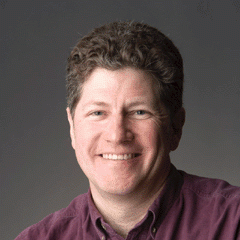
A picture of me in my office.
From October 10 to
December 23, 1995, I visited Nordita.
From February 1 to
April 30, 2001, I visited Tsukuba
University.
Miscellaneous:
Home telephone:
(630) 357-3755
Other Kronfelds on the Internet
Author: Andreas Kronfeld
Revised: 19 March 2008
Created: November 1995